

 Facebook
 X
X
 Pinterest
 Copy Link
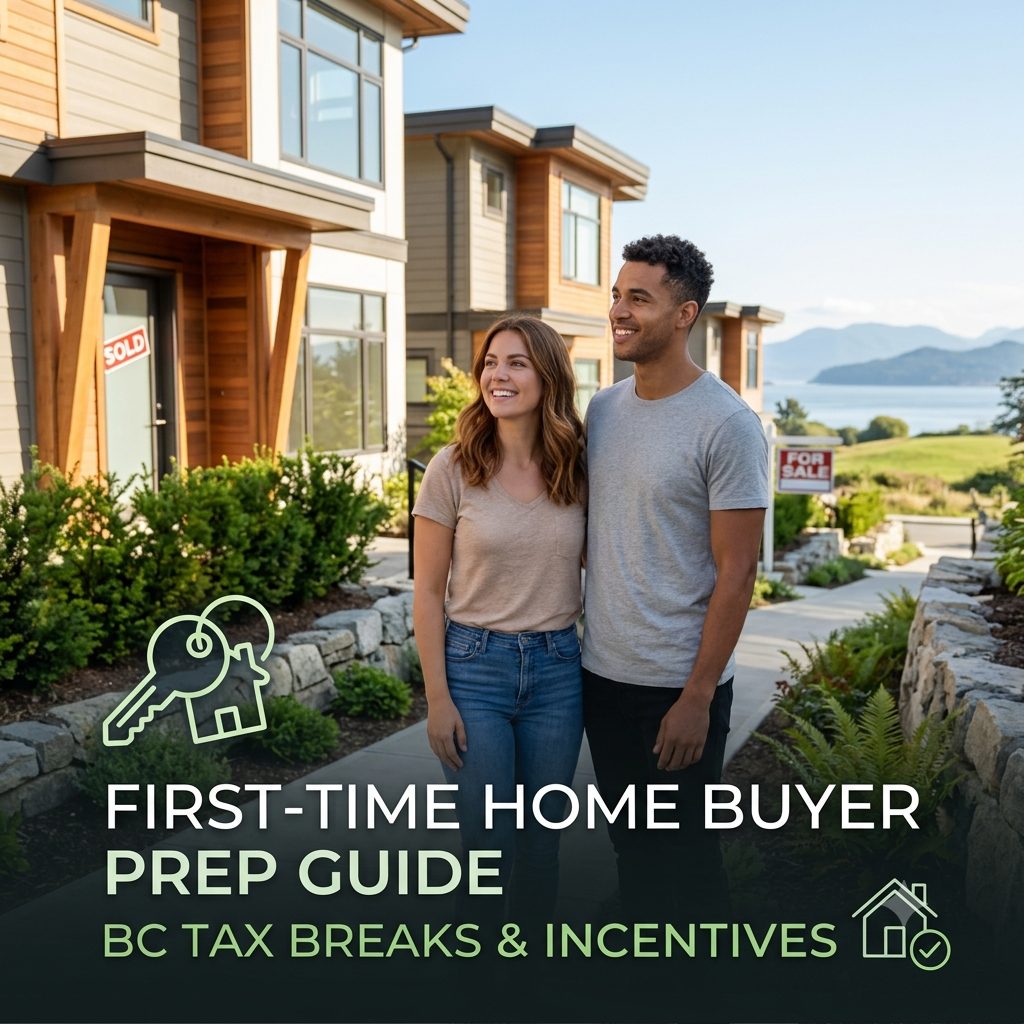
The Ultimate First-Time Home Buyer Prep Guide: Maximizing BC Tax Breaks and Incentives
Getting the keys to your very first home is an incredible milestone. As a realtor, there is nothing quite like watching the excitement on a client’s face when their offer gets accepted. However, let’s be completely honest for a moment. Navigating the real estate market in British Columbia can feel a bit overwhelming without a clear roadmap.
Consequently, managing down payments, deciphering mortgage terms, and tracking closing costs can become stressful, which is why the prep work matters immensely. Fortunately, the provincial and federal governments have rolled out massive updates to help buyers break into the market.
Therefore, if you are planning to make the leap from renter to homeowner this year, here is your step-by-step preparation playbook to save money and stay ahead of the game.
Step 1: Maximize Your Tax-Free Savings Accounts
Before you start browsing listings online, you need to optimize where your down payment savings live. After all, choosing the right accounts can grant you significant tax breaks.
The First Home Savings Account (FHSA)
Introduced recently, the FHSA is arguably the single best tool for Canadian first-time buyers. In fact, it functions like a hybrid of an RRSP and a TFSA. Because contributions are tax-deductible, they directly reduce your taxable income. Furthermore, your withdrawals are completely tax-free when used to buy your first home. Currently, you can contribute up to $8,000 per year, with a lifetime maximum of $40,000. In addition, if you and a partner are buying together, you can both stack your accounts for a combined $80,000 in tax-advantaged savings.
The Home Buyers’ Plan (HBP)
Meanwhile, the federal government also allows first-time buyers to withdraw up to $60,000 from their Registered Retirement Savings Plan (RRSP) tax-free to use toward a down payment. If you are buying with a spouse or partner who also qualifies, that total jumps to $120,000. Subsequently, you will have 15 years to repay the funds back into your RRSP, making it an excellent way to boost your purchasing power early on.
Step 2: Know the BC Property Transfer Tax Exemptions
In addition to saving for a down payment, you must prepare for the closing process. One of the biggest surprises for buyers at the closing table is the provincial Property Transfer Tax (PTT). In BC, the standard PTT is 1% on the first $200,000 of a property’s fair market value and 2% on the remaining balance up to $2 million. For example, on a $750,000 home, that equates to a hefty $13,000 out-of-pocket tax.
As a first-time buyer, however, you can bypass a massive portion of this bill if you plan strategically.
Resale Homes
Specifically, the BC First-Time Home Buyers’ Program offers a full exemption for properties with a fair market value of $835,000 or less, eliminating the PTT entirely on the first $500,000 and providing up to $8,000 in tax savings. If the home is priced between $835,001 and $860,000, a partial exemption applies on a sliding scale. On the other hand, anything over $860,000 does not qualify for this specific first-time buyer relief.
Newly Built Homes
Alternatively, if you prefer a brand-new build or a pre-construction condo, the thresholds are even higher. Indeed, you may qualify for a full PTT exemption on newly constructed homes valued up to $1,100,000, with partial exemptions available on homes valued up to $1,150,000.
Realtor Pro Tip: To qualify for these provincial exemptions, you must be a Canadian citizen or permanent resident. Additionally, you must have lived in BC for at least 12 consecutive months before registration (or filed two BC tax returns in the last six years), and you must never have owned a principal residence anywhere else in the world.
Step 3: Capitalize on New Construction Incentives
If a new build is on your radar, federal legislation has also made it substantially more lucrative for first-time buyers.
For instance, the federal First-Time Home Buyer GST Rebate allows eligible buyers to recover up to 100% of the GST (the federal portion of the tax) paid on a brand-new or substantially renovated home, up to a maximum rebate of $50,000. This full rebate applies to new homes valued up to $1 million, whereas partial relief phases out gradually for properties priced between $1 million and $1.5 million. Ultimately, stacking this GST rebate with the provincial PTT exemption can easily save you tens of thousands of dollars on a new home.
Step 4: Get Pre-Approved and Understand Your Amortization Options
First and foremost, do not confuse a quick online mortgage calculator with a true pre-approval. A formal pre-approval from a mortgage broker or bank locks in your interest rate for 90 to 120 days and outlines your exact purchasing budget.
When you sit down with your lender, remember to ask about the 30-year amortization rules for insured mortgages. Notably, first-time homebuyers making a down payment of less than 20% can opt for a 30-year amortization period instead of the traditional 25-year cap. As a result, this extension lowers your monthly mortgage payment, keeping more cash in your pocket during those initial years of homeownership and helping you qualify for a property that fits your lifestyle.
Step 5: Budget for the Hidden Closing Costs
Moreover, your down payment is not the only cash you need on hand. When I sit down with clients to map out their budgets, I always advise setting aside an additional 1.5% to 2% of the purchase price to cover closing and moving costs.
Accordingly, be sure to account for these essential expenses:
-
Legal Fees: A real estate lawyer or notary is required to handle the title transfer and mortgage registration, typically costing between $1,200 and $2,000.
-
Home Inspection: Expect to spend $500 to $800 to ensure the property is structurally sound.
-
Strata Documents (if applicable): If you are buying a condo or townhome, reviewing the depreciation reports and contingency funds is vital.
-
Property Insurance: Lenders require proof of insurance before they will advance mortgage funds.
Once you successfully close and move in, remember to apply for the BC Home Owner Grant. This annual grant reduces your ongoing residential property taxes by up to $570 in the Capital Regional District, Metro Vancouver, and Fraser Valley, or up to $770 if you purchase outside these major regional districts. Similarly, you can claim the federal First-Time Home Buyers’ Tax Credit on your next income tax return, which yields a non-refundable credit worth up to $1,500 back in your pocket.
The Ultimate Preparation Checklist
| Phase | Action Item | Checked |
| Savings | Open and maximize an FHSA ($8,000 annual limit). | [ ] |
| Financing | Obtain a formal mortgage pre-approval and discuss 30-year amortization options. | [ ] |
| Research | Target homes within the BC PTT exemption thresholds ($835K for resale, $1.1M for new). | [ ] |
| Budgeting | Set aside 2% of your target purchase price exclusively for closing costs. | [ ] |
| Team Building | Partner with a local realtor and real estate lawyer who understand BC property laws. | [ ] |
In conclusion, the BC real estate market moves quickly, but preparation breeds confidence. By structuring your savings through the correct tax shelters and understanding the provincial exemptions available to you, you will position yourself to make a competitive, smart investment. Whenever you are ready to start looking at neighbourhoods and exploring your options, reach out to a local real estate professional for boots-on-the-ground guidance you deserve.
